
Enrollment yield is the percentage of college’s admitted students who go on to enroll in it. It is a simple statistic yet vital to the effective administration and management. It affects critical administrative functions like Planning, Financial Performance, Selectivity and Rankings, and Admissions Strategy, as follows:
- Planning: Yield plays a central role in planning, especially for institutional stability. Colleges have a fixed number of seats, dorm rooms, and course sections. If too few admitted students enroll (low yield), the result for the college will be unrealized revenue and operating losses. If too many enroll (high yield), the college will face overcrowding, housing shortages, strained resources and a diminution of prestige. However, a sound yield forecast enables the enrollment of the desired class size.
- Financial Performance: Tuition is a college’s main revenue source. Administrators use yield to predict how much money in financial aid they will need to offer to collect the targeted amount of tuition. A college with a poorly yield prediction is forced to be cautious. It will tend to be more generous with student aid than necessary to avoid a revenue shortfall. Applicants should identify colleges with low yields that must be disproportionately generous with aid.
- Selectivity and Rankings: Yield plays a major role in the annual college rankings of publications like S. News & World Report. Rankings serve many people as proxies for the quality of a college’s education. A high ranking bestows prestige. It induces admittees to enroll in that college among the others to which they may also have been admitted. Thus begins a virtuous cycle for an Elite school in that it enables the raising of the tuition rate.
- Admissions Strategy. Colleges track yield according to demographics such as major, geography, and academic profile to determine how many students to admit, how to use their waitlist, where to focus recruiting efforts, and how much aid to offer.
Anomaly in Yield Rates by Admissions Selectivity
A recent article in the Learning Network section of the New York Times (April 19, 2026) reviewed yield rates for colleges based on their tier of admission selectivity, as follows:
Table A
Categories of Colleges by Admissions Selectivity
| Selectivity Type | Admission Rate |
| Elite | < 20% |
| Selective | 20% – 40% |
| Somewhat Selective | 40% – 60% |
| Less Selective | 60% – 80% |
| Much Less Selective | > 80% |
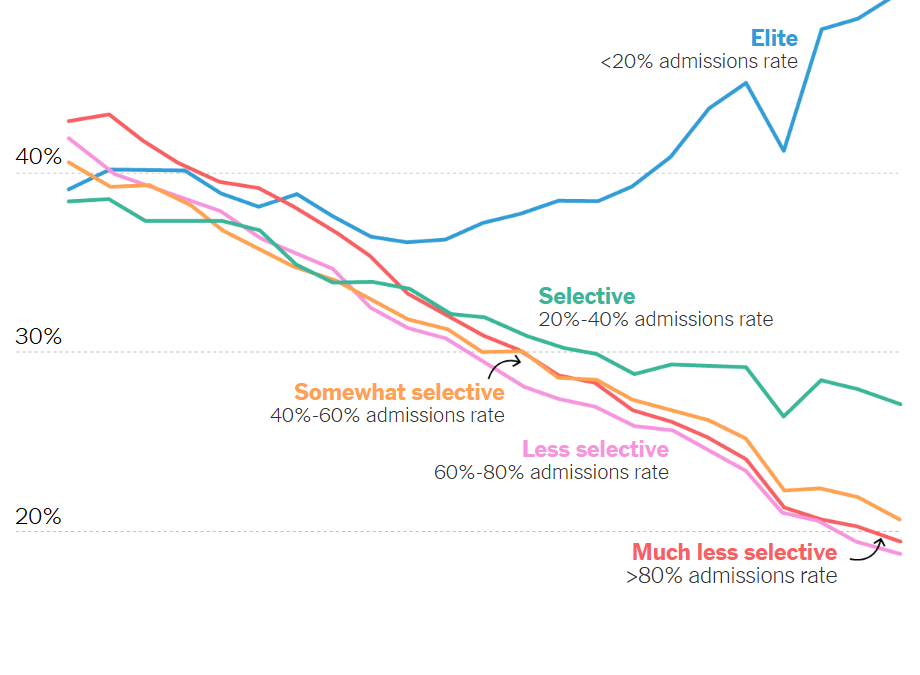
The Times invited all types of participants in college admissions to respond to the article so that they could assemble a balanced picture of the impact of yield. A follow-up article was to be published on April 17. Above is a graph from the Times of April 9 that emphasizes the differential in the yield rate trends of college admissions tiers in Table A.
Graph A shows that over time yield rates at Elite colleges have increased while yield rates at less-than-elite colleges have declined. The graph uses data from the U.S. Education Department’s National Center for Education Statistics. Colleges are grouped into selectivity tiers based on their 2021 admission rates. The graph shows yields for 2021 to 2023.
Elite colleges have higher yield rates because a high percentage of admittees choose to enroll in them. In contrast, lower-tier schools also seek to enroll students who receive multiple admissions but who ultimately decide to go elsewhere. Elite colleges often choose to highlight their yield rates as evidence of their desirability and prestige.
Jeffrey Selingo, a consultant who contributes to the Times on admissions commented:
“Today, a school’s yield rate, like its selectivity, is a sign of status and popularity in an admissions industry that is obsessed with numbers and rankings.”
Mr. Selingo asserts that yield rates are partly driven by students and families seeking status. Many students apply to a several colleges, including highly selective “Reach” schools at which they are unlikely to be admitted. This increases the applications that Elite colleges receive, which in turn lowers their admissions rates since, for the most part, they accept the same number of applicants every year. This reinforces a perception of their exclusivity and adds to their tuition price’s elasticity.
The Times article emphasizes that most colleges actively manage their yield rates. Elite institutions frequently use waitlists and may extend or reopen admissions late in the cycle if they need more enrollees. By controlling how many students they ultimately admit, top colleges can maintain high yield rates and maintain their reputation for selectivity.
Yet, despite wide variances in rankings and admissions rates, most colleges provide a similar educational experience. Research on student engagement shows only small differences across colleges with different levels of selectivity. For example, Selingo states:
“Overall student satisfaction among seniors was separated by only four percentage points between the most selective colleges (those with an admissions rate under 20%) and least selective (those with an admissions rate over 80%).”
Students and families are encouraged to focus less on prestige and more on finding a college that fits a student’s interests, goals, learning preferences, and, most importantly, financial condition. Rather than seeking prestigious brand-name schools, applicants should prioritize those colleges at which they can afford to thrive academically and personally.
COA Tuition Doesn’t Rise in Tandem with Yield
An increase in enrollment yield does not translate into a predictable increase in tuition. The of impact of yield on college administration is comprehensive, as described below:
- Tuition isn’t set in a formulaic way
Colleges don’t have a formula like “+1% yield = +$X tuition.” Tuition is based on broad factors: operating costs, inflation, state and Federal funding, market positioning, and competitor pricing. Yield is important, but only one factor among others.
- Higher yield tends to reduce discounting rather than raise tuition
If a college’s yield improves, it means that more admitted students are choosing to enroll in it. An immediate financial effect is that the college can afford to offer less in tuition discounts (institutional merit aid) in order to fill its class. It folloes that net tuition revenue per student increases. Therefore, the Net Price of Attendance (NCOA), which includes the actual tuition that the college receives increases even if the published Cost of Attendance (COA) stays the same.
- The size of the impact depends on the college
At highly selective schools, which already have high yields, a small change barely matters financially. At less selective, tuition-dependent schools, a small bump can translate into fewer empty seats, less need to forego recenue on discounts, and revenue gains. Growth is indirect rather than via an overt tuition increase.
- Rough magnitude
Instead of tuition going up, a small yield increase might reduce a college’s institutional aid by a few hundred dollars per student or allow the college to admit fewer students to attain the same class size. This can translate into substantial added revenue spread across a class. This is received better than a COA tuition hike.
- Tuition price changes are slow and strategic
Annual tuition increases between, say, 2% – 5%, are typically driven by budgeting cycles, not short-term yield fluctuations.
Summary
An increase in yield most likely will not result in a college raising tuition in the near term. The primary impact of an increase is to give colleges leverage to reduce tuition discounts and realize higher revenue per student without changing the published price of tuition. A declining yield compels a college to sweeten it offers to admittees to induce of them to enroll. It is colleges in this position relative to yield that deserve the closest scrutiny by students who seek the highest quality of education that they can afford.
Recent Comments