
College education strengthens the nation’s most important asset — its people. The Trump administration has developed a strategy for reforming college education that isn’t based on formal doctrine. Rather, it’s a conservative, market-oriented framework that integrates the main tenets of the administration’s public policy. Its themes include:
- Reduce the Federal role in education,
- Emphasize on merit-based policies rather than race-based policies,
- Oppose DEI programs,
- View colleges as workforce preparation,
- Create greater market competition and institutional diversity, and
- Use Federal funding as leverage to foster desired outcomes.
The administration’s posture differs sharply from the Biden administration’s. Biden called for strengthening Federal oversight, expanding access and affordability, loan forgiveness, consumer protection, and national competitiveness. The Trump administration’s approach is characterized by a shift in authority from the Federal government to states and institutions, reducing Federal regulation, and eliminating or downsizing the ED by transferring its responsibilities to other Federal agencies.
The importance of student loans in the American economy is underscored by the fact that 43 million Americans have accrued $1.7 trillion in student loan debt. This is twice the size of all college endowments combined and exceeds both cumulative credit card and auto loan debt. This makes the ED is the nation’s fifth-largest bank by assets.
Secretary McMahon’s Overview
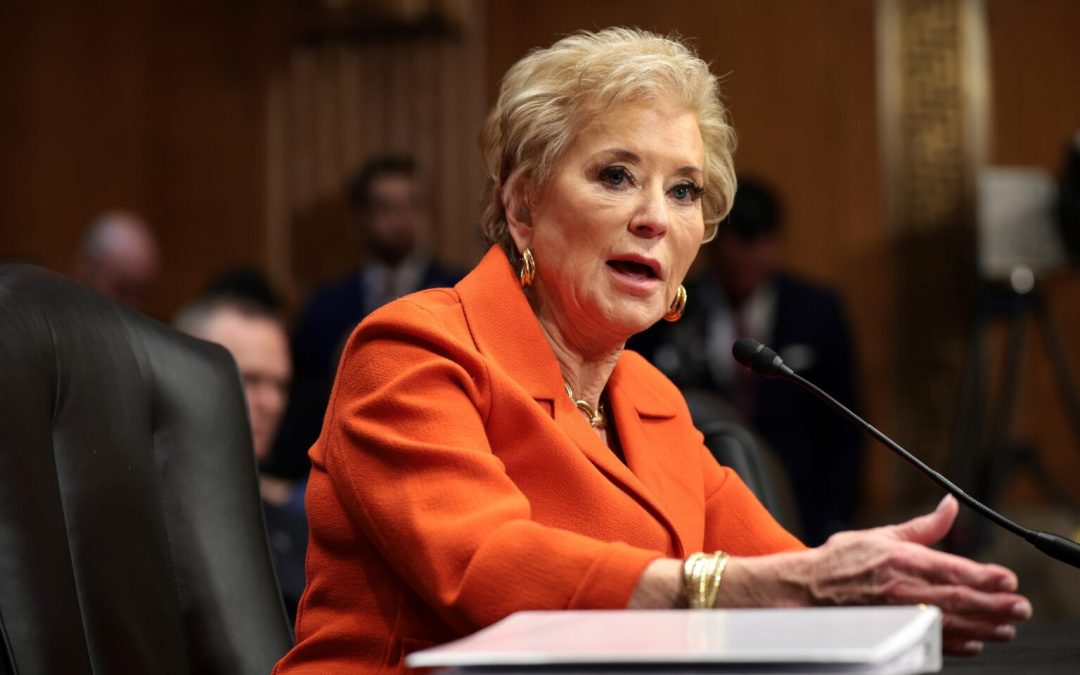
In an open letter in the Washington Post on March 12, ED Secretary Linda McMahon summed up the administration’s policy direction. She framed the subject as follows: “Since taking office, the Trump administration has tackled the exploitative behavior of institutions burdening everyday Americans. One of the least recognized contributors to consumer debt has produced one of the largest debt portfolios in America: colleges and universities.”
Secretary McMahon says that the administration is taking steps to fix the “Broken Federal student loan system”. It is being redesigned to make borrowers and colleges more accountable for their own decisions.
McMahon emphasizes that Federal investment in education without accountability is pointless and imprudent. Colleges have treated taxpayer-backed loans as their entitlement. This being the case, they are not averse to steering students into low-ROI programs while simultaneously raising tuition to record levels. Congress has allowed students to borrow up to a college’s Cost of Attendance in order to pay tuition, but the risk of default is borne by taxpayers rather than the college.
McMahon stresses that “As a beneficiary of Federal student loan funding, institutions have a moral and legal obligation to support the students whose borrowing sustains their operations.” To continue to receive the proceeds from Federal student loans, over 1,100 colleges are in danger of losing access to loans due their default rates being above 40%. They must get this rate below 40% in order to have their access restored.
In addition, McMahon states that, “To help keep default rates down, the ED recently encouraged schools to adopt common-sense practices that support students. This includes informing borrowers in default about opportunities to rehabilitate their loans, enhancing entrance counseling using earnings data published by the ED, and setting lower borrowing limits for programs with lower earnings potential.”
Assuring a Return on Investment in Education
Most students borrow in the belief that the degree they seek will assure them of attaining the American Dream. Yet, as it turns out, many of them will not see any return on the cost of their college education. Students who borrow to invest in their education shouldn’t regress financially. Steps are being taken to remedy this possibility.
According to McMahon, if a degree program doesn’t leave a student better off financially, then the ED will revoke the program’s ability to receive Federal loan funds. About 23% of undergraduate and 43% of master’s degree programs degrade graduates financial condition even worse than if they had simply never enrolled. In some fields, the numbers are even more alarming. About 85% of master’s degrees in arts, humanities, and theology have negative ROI’s. According to McMahon, “Students deserve the truth. Just as doctors disclose the risks of taking a medication, students need to know if their education will yield better or worse financial outcomes.”
The Omnibus Spending Act of 2025 (the One Big Beautiful Bill Act) established an earnings test for college degree programs. If a bachelor’s program graduate doesn’t earn at least as much as a high school graduate, the college will be warned that the degree program will no longer be eligible to receive Federal funds unless the situation is remedied. In a similar manner, graduate degree earnings are compared to those of undergraduates. An earnings test has also been added to the FAFSA process so that families can see the expected ROI of a college degree program prior to enrollment rather than years later after debt has accrued.
Protecting Borrowers by Capping Amounts Borrowed
The ED is implementing maximal limits on graduate student loans, a reform that will stop unlimited borrowing in these programs. The current system doesn’t place any limit at all on students, families, or colleges. If a student can borrow whatever amount a school decides to charge, colleges lack an incentive to control costs. If not remedied, this problem would continue to force taxpayers to fund unproductive degrees that result in negative ROI’s.
Rewarding Sound Financial Decisions
Student loans exist to serve the best interests of students, not colleges. According to McMahon, “Student loans should foster opportunity, not serve as blank checks for colleges to raise tuition. As the Trump administration works to make the American Dream achievable for every family, we are strengthening every step of the higher-education journey — from completing the FAFSA form to enrolling and borrowing responsibly that leads to successful repayment.”
According to the Trump administration, an American family should be rewarded if their outstanding loan balance declines with each payment. Under the ED’s new Repayment Assistance Plan, every on‑time monthly loan payment triggers a $50 matching principal payment from the ED as a reward. In addition, families realize a $50 reduction in their monthly payment for each dependent child.
************
Although advocating less Federal control overall, the Trump administration supports using student loan funds to manage family and institutional behavior. The philosophy of the Trump administration is that Federal money should be used to advance national priorities in education such as high academic achievement and ideological neutrality.
Recent Comments